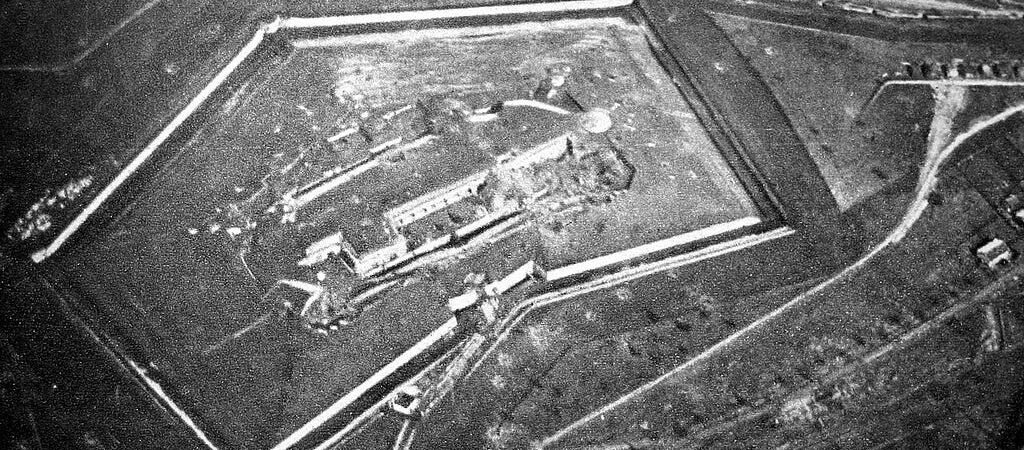
Verdun did not produce one savior. It produced one of the most durable military legends in modern French history. The problem with the familiar formula. Pétain as the single “Hero of Verdun” is not that it gives him some credit. It is that it gives him too much, and in doing so flattens a far more complex chain of responsibility, decision-making, and victory.
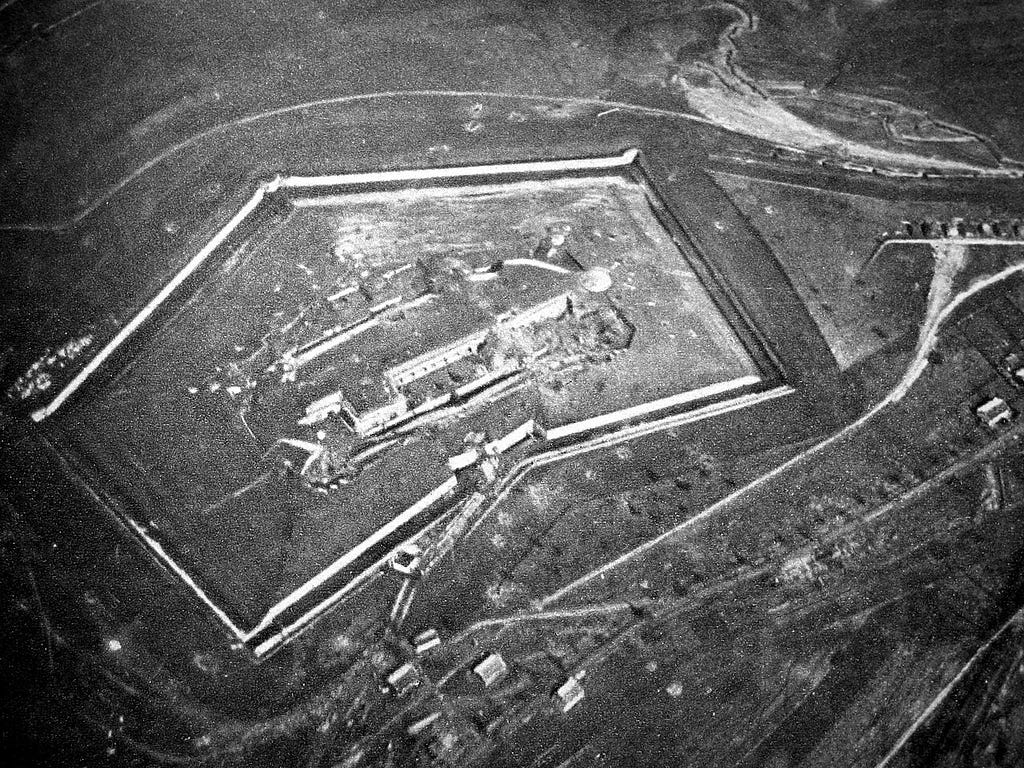
Verdun was prepared in part by Castelnau, sustained in part by Pétain, and tactically recovered under Nivelle. The legend came later. The simplification came later. The monopoly of glory came later.
Verdun became political before it became mythical
A serious argument about Verdun has to begin with one uncomfortable fact: on the French side, the decision to hold Verdun at all costs was not purely military. Historians of memory and the battle itself have stressed that Verdun rapidly became more than a sector on the map. It became a political symbol, then a national myth. That mattered enormously, because once Verdun was treated as a test of national endurance, the story of the battle was always going to be simplified into a story of salvation.
That is why the later cult of Pétain matters so much. It was not just a matter of tactical history. It was a matter of national storytelling. Verdun became the French battle of the war in public memory, and the temptation to attach that symbolic weight to one name was powerful from the start. But symbolic clarity is not the same thing as historical truth.
Castelnau mattered before Pétain arrived
If the argument is about who actually prevented disaster in the opening phase, Édouard de Castelnau cannot be treated as a footnote. In late January 1916, while Verdun was still not being treated as the top priority by important elements of French high command, Castelnau inspected the sector and concluded that the precautions taken there were inadequate. He pushed to keep divisions in place, accelerate defensive works across a vast front, extend the sector, and reinforce heavy artillery. In other words, he reacted before the blow fully landed.
His importance became even clearer once the German assault began on 21 February. As the French front buckled and senior commanders feared collapse, Castelnau anticipated the scale of the emergency, redirected reinforcements toward the Verdun area, and on 25 February explicitly ordered that the right bank of the Meuse had to be held at all costs. That decision matters because abandoning the east bank would have meant abandoning the very ground from which Verdun could be dominated. In the worst hours of the opening crisis, Castelnau was not polishing a legend. He was stopping a rout.
This is the part of the story the Pétain legend tends to erase. By the time Pétain took command, some of the most decisive emergency choices had already been made: Verdun had been reinforced, the defense had been stiffened, and the option of simply letting the right bank go had been rejected. That does not make Pétain irrelevant. It does make the “sole savior” narrative impossible to defend.
Pétain’s real role was important, but it was not exclusive
Pétain’s real place at Verdun is serious enough that it does not need inflation. After taking command of the Second Army, he helped stabilize the defense, imposed the rotation system later known as the noria, and used the Bar-le-Duc–Verdun road — the future Voie Sacrée, to keep men, food, and ammunition moving into the battle at relentless speed. That was not myth. That was organization, and organization saved armies.
He also represented, tactically and doctrinally, a French army moving away from old fantasies of pure offensive spirit and toward a harder truth: artillery, logistics, and controlled firepower would decide modern battle. At Verdun, that mattered. Pétain deserves credit for that adaptation. But giving him credit for what he actually did is precisely why one should resist giving him credit for everything. He did not prepare the ground alone, he did not make every decisive choice of the opening days, and he did not command the full arc of the battle through to the final French recovery.
Nivelle won back the ground — and lost the memory war
The most neglected part of the Verdun story in Anglophone writing is often the simplest one: Robert Nivelle was not just present at Verdun. He was central to the French recovery. When Pétain was promoted to command Army Group Centre in early May 1916, Nivelle replaced him at the head of the Second Army. From there, he oversaw the offensive phase that gave France back the initiative. Britannica notes that his creeping-barrage methods helped deliver the successful French counterattacks of October and December 1916, which retook nearly all the ground the Germans had gained over the previous six months. The International Encyclopedia of the First World War is just as clear: at Verdun, Nivelle was tasked with containing the Germans and, if possible, forcing them back; by the end of 1916, he had done exactly that, winning immense prestige at the time.
This is not a semantic point. Douaumont was retaken in October. Vaux was recovered shortly after. The December offensive pushed the Germans back toward their earlier positions. Those are not decorative episodes added to an already completed defense. They are a major part of why Verdun ended as a French success rather than merely a French survival. If one man is remembered as the embodiment of endurance while the commander of the successful reconquest is reduced to a historical aside, then memory has plainly done violence to the record.
Even one of Verdun’s most famous slogans points in that direction. The line later condensed into “they shall not pass” is tied by major reference works to Nivelle’s June 1916 exhortation. In other words, even the language wrapped into the French myth of Verdun does not belong neatly to the man who ultimately absorbed most of the glory.
Why memory crowned Pétain
So why did Pétain eclipse Nivelle? Because military memory is never just military. Verdun became a national battle partly because Pétain’s rotation system brought a huge portion of the French army through the sector. That broadened the emotional ownership of Verdun and attached his name to the experience of an entire generation of soldiers.
Then came 1917. Nivelle’s failed offensive on the Chemin des Dames wrecked his reputation. Later historians have noted that this failure was over-personalized and politically useful, but the effect on memory was brutal: Nivelle’s Verdun prestige was retrospectively poisoned. Pétain, by contrast, could capitalize on the authority he had gained with soldiers and veterans. One modern study of French war memory notes plainly that, in fairness, Nivelle was the commander who retook Douaumont and pushed the Germans back, but that his 1917 disaster disqualified him in the eyes of many veterans; Pétain, meanwhile, installed himself in the commemorative landscape by repeatedly presiding over Verdun ceremonies, including the inauguration of the Douaumont Ossuary.
That is the core of the issue. The title “Hero of Verdun” was not simply awarded by the battlefield. It was built by politics, veterans’ culture, public ceremony, and the later collapse of Nivelle’s reputation. Once that machinery is visible, the legend looks less like historical destiny and more like a successful act of memory management.
Verdun deserves a better reckoning
None of this requires the childish counter-myth that Pétain “did nothing” at Verdun. He did something real and consequential. He helped make the defense sustainable. He organized endurance. He helped turn logistics into resistance. But that is not the same as saying he alone saved Verdun, still less that he uniquely won it.
A more honest verdict is harder and better. Castelnau saw the danger early and acted before the battle became a national trauma. Pétain organized the defensive system that kept Verdun from collapsing. Nivelle commanded the successful reconquest that turned survival into recovery. The poilus paid for all of it. The later cult of one man did not clarify that history. It obscured it. And that is exactly why the “Hero of Verdun” legend deserves to be challenged, not preserved out of habit.